As a starting point, if a child is experiencing mental health crisis or in immediate danger this should be prioritised and appropriate support sought. Mental health crisis – 111 option 2 Immediate safety concerns – 999.
1. Introduction
1.1 This guidance aims to support professionals recognising when sexual behaviours by children are considered harmful. Harmful Sexual Behaviours (HSB) are defined as; sexual behaviours expressed by children under the age of 18 years old that are developmentally inappropriate, may be harmful towards self or others, or be abusive towards another child, young person, or adult, online (Technology Assisted HSB) and offline.
1.2 Technology-assisted harmful sexual behaviour (TA-HSB) is when children and young people use the internet or other technology to engage in sexual activity that may be harmful to themselves and others. TA-HSB covers a range of behaviour including the developmentally inappropriate use of pornography, online sexual abuse, grooming, sexting. Children and young people who engage in technology-assisted harmful sexual behaviour | NSPCC Learning
Healthy sexual development is a natural part of overall child development. It is important to note that children’s development does not always align with chronological age.
Click on the link below for further guidance on healthy sexual development in children. Harmful Sexual Behaviour Initial assessment and identification for professionals
2. Recognising HSB
2.1 Hackett’s continuum of need presents sexualised behaviour as a range from ‘normal’ to ‘inappropriate’, ‘problematic’, ‘abusive’ and ‘violent.
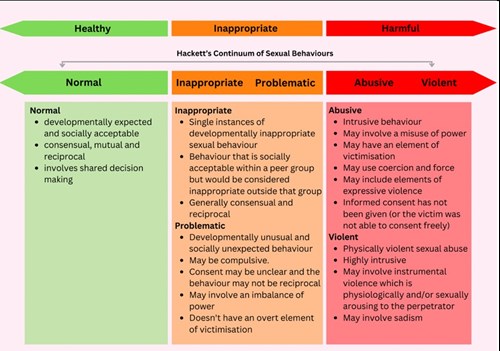
2.2 NSPCC - Understanding Sexual Behaviour - Wakefield Safeguarding Knowledge Hub Technology is an integral part of children’s relationships and development and so should be viewed within the same continuum which can include
developmentally appropriate, problematic and harmful. AIM Practice Notes - Technology-Assisted Harmful Sexual Behaviour (TA-HSB)
3. Response
3.1 If the recognised behaviours fall within the amber or red categories, or the practitioner is unsure they should discuss the case with their safeguarding lead or within supervision and follow local procedures for working with children who display HSB.
3.2 Working together to Safeguard Children (2023) identifies key principles that are essential when working with children who sexually harm, or children who are sexually harmed. The guidance outlines the importance of effective multi agency working as well as ensuring the needs of all children affected by the HSB (directly or indirectly) are supported. Working together to safeguard children - GOV.UK
4. Support Services
4.1 Therapeutic service offering psychoeducation and strengths-based safety planning for children and families affected by HSB. Sunrise Therapy Service | Barnardo's
5. Useful Information, Resources and links
- A safe space for teenagers worried about sexual behaviour. Home - Shore
- Safety planning (on and offline), support and a wide range of resources to support anyone with concerns about child sexual abuse and its prevention. Lucy Faithfull Foundation - Preventing child sexual abuse
- Information around the scale, nature and impact of HSB as well as guidance and support around safety planning and education. Home | CSA Centre
- HSB toolkit for schools. Toolkits | Contextual Safeguarding
- The young people’s sexual behaviours mapping tool. The young people's sexual behaviours mapping tool - University of Birmingham
- Resource to support assessment and decision making. How does the Sensoa Flag System methodology work? | Sensoa
- Assessment tool specific for age 3-11. Microsoft Word - sharc coding guidelines 2025 version 17.docx
- The AIM Project – Assessment of HSB and resources.